
It is one of the strangest product names in the home category. Walk through any bedding aisle and you will find a large upright cushion with two stubby padded arms, often with a little handle on top, sold under a name that has nothing to do with what it is or what it is made of: the husband pillow. Nobody blinks at a reading lamp or a sofa cushion, but a pillow named after a spouse invites the question almost everyone eventually asks, which is simply why.
The honest answer is that nobody can point to a first use, a patent filing or a brand campaign that coined it. What we can do is lay out the explanations that circulate, explain which parts of them hold up, and then spend the rest of this article on the more useful question: what the thing actually does, why the arms matter more than the back, and how to tell a good one from a sack of shredded foam with a zip.
What a husband pillow actually is
Strip the name away and the product is a backrest. It is a cushion built to be used vertically rather than horizontally, with three structural parts that distinguish it from an ordinary bed pillow.
The first is the back panel, which is tall and fairly firm. It runs from roughly your tailbone to somewhere between your shoulder blades and the back of your head, depending on the model and your height. Unlike a sleeping pillow, it is not meant to compress much. A back panel that collapses under your weight has failed at its only job.
The second is the pair of arms. These are the padded wings that stick forward on either side, usually a third to half the height of the back panel. They are what make the product more than a wedge. They catch your elbows and forearms so your shoulders are not holding your arms up all evening, and they stop your torso from sliding sideways when you shift position.
The third, and the most overlooked, is the base. Good backrests have a flat, slightly weighted or stiffened bottom edge so the whole thing sits square on a mattress instead of tipping backward every time you lean into it. Cheap ones have no base structure at all, which is why they end up folded into a banana shape behind your back within a month.
Where the name comes from
Here is the part that deserves more honesty than it usually gets online. Search the question and you will find a dozen pages confidently stating an origin. Follow the citations and they lead nowhere, usually to each other. There is no dictionary entry tracing a first attested use, no manufacturer claiming to have invented the term, and no advertising archive that pins it to a campaign.
What exists are two explanations, repeated often enough that they have become the standard answer.
Explanation one: it stands in for a person
The most common claim is that the pillow is named for what it replaces. Lean against a partner sitting up in bed and you get a warm, slightly yielding back support with two arms that happen to be in roughly the right place to rest your own on. The cushion reproduces that shape in foam. Under this reading the name is a joke about substitution, in the same family as the "boyfriend pillow" products that lean into the gag much more literally with a stuffed arm and shoulder.
This explanation has the virtue of matching the object. The arms really are the defining feature, and they really do correspond to the thing a person's arms would do. It is also consistent with a related nickname some households use, the silent husband, which carries the same idea with the joke made explicit.
Explanation two: it is who was pictured using it
The second explanation reverses the logic. Rather than replacing a husband, the pillow was named for the household member stereotypically shown propped up in bed with it, reading the paper or watching television late. Backrest cushions were a visible presence in bedrooms through the second half of the twentieth century, and the name may simply have attached itself to the user rather than to the function.
This version is harder to verify and harder to disprove. It fits the period, but period fit is not evidence. Treat it as plausible rather than established.
What we can actually say
Both stories are folk etymology: explanations constructed after the fact to make sense of a name whose real origin was never recorded. That is extremely common with informal product names, which spread through speech and catalogs long before anyone thinks to write down where they came from. Anyone telling you the definitive answer is reconstructing, not reporting.
The more defensible statement is this: husband pillow is an informal retail name for a backrest cushion with arms, in circulation for decades, now used alongside more descriptive terms like reading pillow, bed rest pillow and backrest pillow. If you want to search for one and compare models, those descriptive terms will give you better results, because they are what the larger manufacturers actually print on the box.
What the arms are really for
It is tempting to read the arms as decoration or as a way to make the product look like a chair. They are neither. They solve a specific posture problem that a stack of ordinary pillows cannot.
Sit up in bed against a headboard and your body makes a shape it was not designed to hold. Your lower back has nothing behind it, so your pelvis rolls backward and your spine curves into a C. Your arms hang unsupported, which means your shoulders and the muscles across your upper back carry their weight continuously. Within twenty minutes you start to slide down the headboard, and the reason is not laziness. It is that nothing is holding the shape.
The arms interrupt that chain. With forearms resting on padded supports at roughly elbow height, the shoulders unload. The upper back stops working to hold the arms up, and the whole torso stops drifting forward, which is what starts the slide. That is why people who try a backrest for reading or laptop work often describe the difference as being able to stay put rather than being more comfortable in the first minute.
The same mechanism is why these cushions turn up so often in specific situations: recovery after surgery, late pregnancy, nursing, extended reading, or anyone who works from bed because the house has no better spot for it. If that last one describes you, a proper seat is the better fix, and our seating guides cover options that do not involve working from a mattress.
Fill types and why they decide everything
Two backrests can look identical on a product page and behave completely differently, because the fill is what determines whether the back panel holds its shape under your body weight.
Shredded memory foam
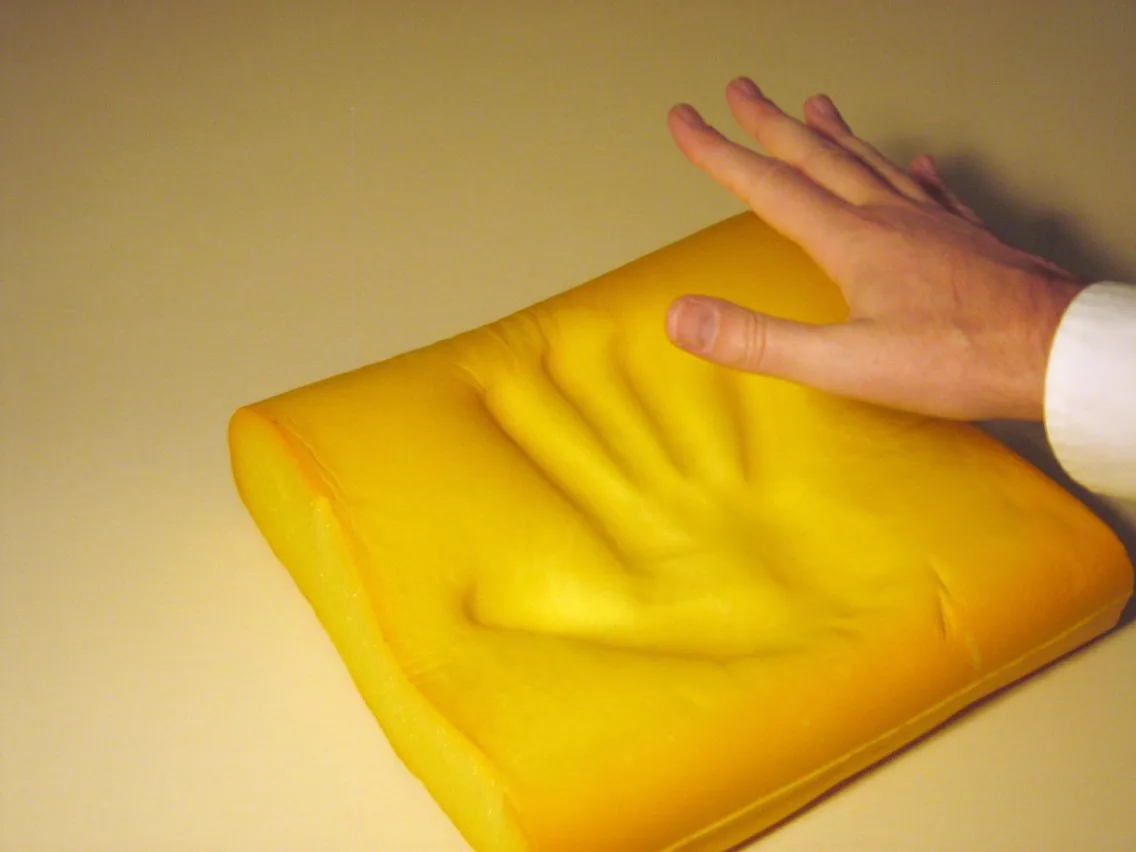
The most common fill in the mid-range. Chopped foam pieces move around inside the cover, so the cushion conforms to your back rather than forcing a fixed shape on it, and most models let you unzip the cover to remove or add fill. That adjustability is the real selling point: a backrest that is too tall or too firm for you can be tuned, which is not true of a solid foam core.
The weakness is settling. Shredded fill migrates downward over months of use, so the top of the back panel goes soft while the bottom packs hard. The fix is to pull the cushion apart and redistribute the fill by hand every few months, which takes about two minutes. If you shake the pillow and knead it back into shape when it starts to feel uneven, it will hold up far longer than if you ignore it.
Solid foam core
A single block of polyurethane or memory foam, sometimes with a shaped profile. It holds its geometry much better than shredded fill and will not develop a hard-packed bottom edge, which makes it the better choice if you want consistent support over years.
The tradeoff is that you get the shape the maker chose. If the back panel is too upright for your headboard or too tall for your shoulders, there is nothing to adjust. Check the stated height and the angle before buying, since a solid core is a commitment.
Polyester fiberfill
The budget fill, and the one that disappoints most often in this product category. Fiberfill is excellent in a decorative cushion and poor in a structural one, because it compresses and then stays compressed. A fiberfill backrest usually feels supportive for the first week and like a flattened sack by the second month. If the listing does not state a fill type, assume fiberfill.
How to choose one that works
Five things decide whether a backrest earns its space, and only one of them is comfort as such.
Height against your own back
Measure from the mattress surface to the point where you want support to end, usually the base of the shoulder blades for reading or the base of the neck if you want head support too. Then compare that to the product's stated height. A backrest much taller than you need pushes your head forward and gives you a sore neck; one much shorter leaves the upper back unsupported, which puts you back in the slumping position you were trying to escape.
Arm height and spread
The arms need to land where your elbows naturally fall, which for most adults is somewhere between a third and half the height of the back panel. Arms set too low do nothing. Arms set too high push your shoulders up toward your ears, which is worse than no arms at all. Width matters too: a narrow backrest with the arms close together will squeeze a broad-shouldered user, while an overly wide one lets you sink sideways between the arms.
A base that stays put
Look for a flat bottom edge and, ideally, some structure in the base. A backrest that tips backward under load transmits every lean into the headboard, which is noisy, and it slides. If a model has no visible base structure in the photographs and no mention of it in the description, expect to be repositioning it constantly.
A cover you can wash
This cushion sits against hair, skin and whatever you spill on it while reading in bed. A removable, machine-washable cover is not a luxury feature here, it is basic maintenance. Check that the zip runs far enough to actually get the cover off, since a short zip on a bulky cushion is a genuinely frustrating ten minutes.
A carry handle
Small detail, real difference. Backrests get moved: off the bed at night, onto the sofa, into another room. A fabric loop on the top edge makes that a one-handed job rather than a hug.
When something else is the better answer
A backrest is not always the right purchase, and it is worth saying so plainly.
If you mostly want to sit up to watch something in the evening, and the bed is not actually where you want to be, the problem is the room rather than the pillow. A chair with real back support solves it better and gets you out of the bedroom, which tends to help sleep quality as well. A floor lamp beside that chair matters more than most people expect, and our guide to living room floor lamps covers how much light a reading seat actually needs.
If you need elevation for a medical reason, such as reflux or breathing difficulty while sleeping, a backrest is the wrong tool. Those situations call for a wedge that supports you while lying down, or an adjustable bed base, and the right advice there comes from a clinician rather than a bedding article.
If you want to prop up a laptop, a backrest helps your torso but does nothing for your wrists or the screen height. Pair it with a lap desk, or accept that extended laptop work in bed is going to cost you something regardless of the cushion.
Keeping one in shape
Backrests fail from neglect more often than from wear. Three habits cover almost all of it.
Redistribute shredded fill every few months. Unzip, reach in, break up the compacted mass at the bottom and pull some of it back toward the top. Two minutes of this restores most of the support people assume is permanently gone.
Wash the cover on a cold cycle and air dry it. Heat shrinks covers, and a shrunken cover on a full-size cushion is effectively a destroyed cushion, because you will never get it back on without stressing the seams.
Store it upright rather than squashed under something. A backrest left compressed under a pile of bedding for a season comes out with a permanent fold in the back panel, and foam does not forget a fold easily.
Why a stack of ordinary pillows does not do the same job
Almost everyone tries the free version first: three or four bed pillows piled against the headboard. It works for about ten minutes, and understanding why it stops working explains what you are actually buying when you buy a backrest.
A sleeping pillow is engineered to compress. That is the whole point of it, since its job is to let your head sink to a neutral neck angle. Stand that same pillow on its edge and put the weight of your torso against it and it does exactly what it was designed to do: it collapses. Stack three and you get three compressed layers plus the gaps between them, which is why the pile slowly shuffles out from behind your back and ends up on the floor.
There is a second problem that is less obvious. A stack has no defined lower edge, so nothing supports the small of your back at the point where support matters most. Your pelvis keeps rolling backward, and the stack does nothing to stop it. A purpose-built backrest puts a firm, flat panel exactly there, which is why it holds a posture that a pile cannot.
The third difference is lateral. A stack offers no sideways containment at all, so every time you reach for a drink or turn a page your torso drifts and the pillows redistribute. The arms on a backrest hold you between them. It feels minor on a showroom floor and it is the single thing regular users mention most.
Where it fits in the room, and where it does not
A backrest is a large object. Full-size models are roughly the volume of a small armchair cushion, and that has consequences for a bedroom that most product pages skip.
During the day it has to live somewhere. On a double or larger bed it can sit against the headboard as part of the made bed, where it reads as a deliberate layer rather than clutter. On a single bed, or on a bed in a room that doubles as anything else, it tends to look like a cushion that lost its sofa. A model with a carry handle and a cover that matches the bedding solves most of that, since it can move to a chair or a closet shelf in one trip.
It also changes how the bed works as a piece of furniture. A tall backrest left in place effectively turns the bed into a daybed, which is useful in a studio where the bed is the main seat and a problem in a bedroom you want to read as a bedroom. In a studio, the honest comparison is not against other pillows at all: it is against a small sofa that gives you a seat with a back, a frame and no association with sleep. Our guide to sectional sofas for small living rooms covers what that costs in floor space.
One last practical point: a backrest and a tall upholstered headboard can fight each other. If your headboard already has a soft, angled surface, a thick backrest pushes you further forward than you expect and may put your head in front of your shoulders. Sit on the bed and measure before ordering, rather than assuming the two will stack neatly.
Common questions
Is a husband pillow the same as a reading pillow?
Yes, in practice. Reading pillow, bed rest pillow, backrest pillow and husband pillow all describe the same category: an upright cushion with arms, used sitting up. Manufacturers tend to use the descriptive names on packaging and the informal name in marketing copy, because that is what people search for.
Is there a wife pillow?
Not as an established product name. The asymmetry is part of what makes the husband pillow name interesting, and it is one of the reasons to think the name attached to a stereotype rather than to a function. Some sellers have tried the counterpart name, but it has never taken hold.
Do the arms actually help, or are they decoration?
They are the functional core of the design. A backrest without arms is a wedge, and a wedge supports your spine but leaves your shoulders carrying your arms. The arms are what let you stay in position for an hour rather than fifteen minutes.
What size should I get?
Match the back panel height to the distance from your mattress to the base of your shoulder blades, adding a little if you want head support. Most adults land in a mid-size model. Oversized versions suit taller users and anyone who wants to sit fully upright with head contact, but they overwhelm a small bed and are harder to store.
How long should one last?
A solid foam core backrest with a washable cover, used daily and stored properly, should hold its shape for years. A shredded fill model will hold up similarly if you redistribute the fill periodically. A polyester fiberfill model should be treated as a one-season purchase, which is worth factoring into what looks like a bargain.
The bottom line
The name is a historical accident that nobody wrote down, and the two explanations you will read everywhere are reconstructions rather than records. That is the honest answer, and it is more useful than a confident invented one, because it frees you to ignore the name entirely when shopping.
What matters is the object: a tall back panel that does not collapse, arms that land at your elbows, a base that stays flat, a fill type you can maintain and a cover you can wash. Get those five right and you have bought a piece of furniture that quietly fixes an everyday posture problem. Get them wrong and you have bought a large decorative cushion with a funny name.